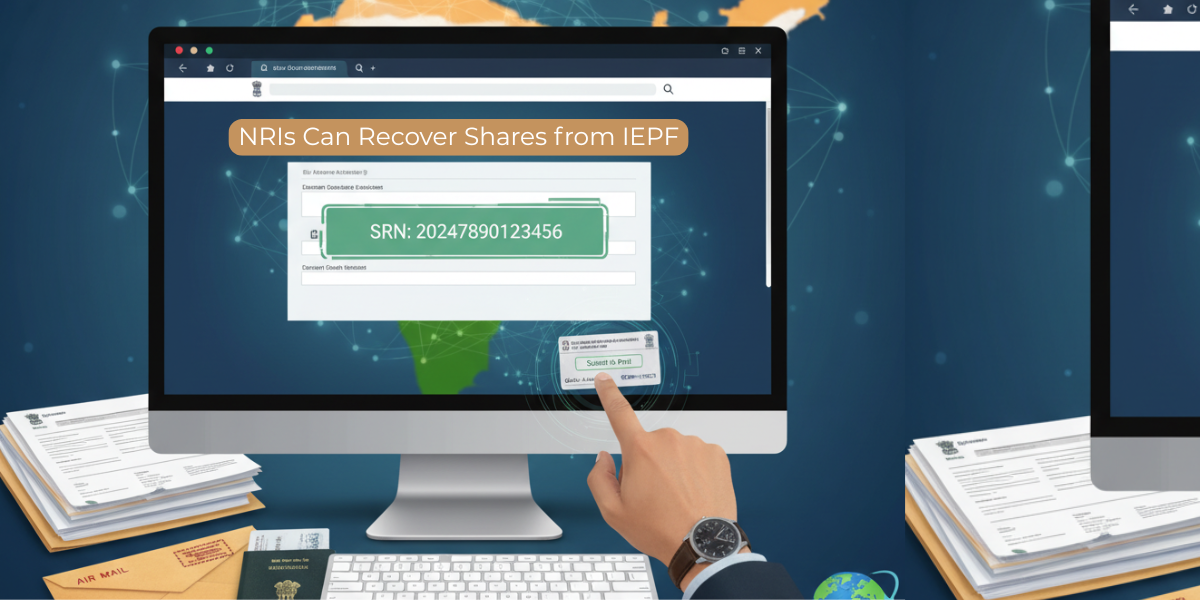
Many Non-Resident Indians (NRIs) or their parents would have bought shares in India while they were residing in India. Subsequently, due to address changes and change in country of residence, they would have missed communications sent by the Companies or may have lost share certificates during transit. As a result, these investments would have become untraceable over time and Dividends would have remained unclaimed.
As per law, these shares and unclaimed dividends would have been transferred to the Indian government custody – specifically, to Investor Education & Protection Fund (IEPF)
As of 2025, the Investor Education and Protection Fund (IEPF) holds more than ₹82,000 crore worth of unclaimed shares & dividends across over 1,500 companies — a clear sign of how much wealth has been left unclaimed. Fortunately, NRIs can reclaim their lost investments and dividends – without needing to visit India – by following a defined recovery process.
Pre-requisites to start the claim process:
The NRI shareholder or NRI claimant (in case original shareholder has expired) should have the following documents before applying for the claim:
PAN Card
NRE / NRO bank account in India & cheque book
Overseas Address Proof
Active Demat account in India
These documents may need to be notarized or attested by the Indian Embassy or a local notary.
Step 1: Communicate with the Registrar / Company
Send an email to the Company / Registrar mentioning the Folio No. and enquiring about the present status of the shares. If share certificates are available, please enclose the certificate copies with the email along with PAN, address proof of the shareholder / claimant.
If original shareholder has expired, please enclose the Death Certificate copy also.
Some companies / Registrars may need filled KYC forms – ISR1, ISR2, ISR4, SH-13 – along with the request letter.
Step 2: Prepare documentation as required by the Company / Registrar and obtain Letter of Entitlement
After receiving the status and documentation details from the Company, the NRI shareholder / claimant will need to obtain a “Letter of Entitlement” from the Company. The “Letter of Entitlement” mentions exact amount of dividends unclaimed year-wise and the no. of shares to be claimed from IEPF.
Step 3: File IEPF Claim Online
After receiving the “Letter of Entitlement” the claim can be filed online at IEPF Portal by filling Form IEPF-5. All necessary documents like PAN, Address Proof, Share Certificates, Letter of Entitlement need to be attached while filling the form IEPF-5.
Once the claim has been filed successfully online, a Service Request No. (SRN) will be generated. Please take a print of the SRN and sign it. The signed SRN along with hard copies of IEPF-5 form and all supporting documents need to be couriered to the Nodal Office of the Company immediately.
Step 4: Keep track of your email id – including spam folder for IEPF Approval / Discrepancy emails
The Nodal officer scrutinizes the documents and sends a eVerification report to IEPF if all documentation is in order. Thereafter, IEPF processes the documents again for 2nd level of approval.
Conclusion
The IEPF claim process is well defined and not too cumbersome. There is no requirement of a personal visit to the Company / Registrar / IEPF. However, For NRIs who live abroad, the process can seem challenging, but with the right guidance, it becomes simple and stress-free.
At Deepam Finvest, we assist NRIs in recovering their rightful investments from IEPF transparently. Get in touch with us today to begin your recovery journey.